
Strong H1 puts €180bn 2026 in sight, but spreads still safe
Strong supply in the first half of the year has led some analysts to raise their forecasts for fully year euro benchmark issuance towards €180bn, but a consensus remains that modest net supply in the second half should support the spread performance of covered bonds.
 In spite of geopolitical and other headwinds, euro benchmark issuance in the first six months of the year reached €120bn – up 18% on H1 2025 and the third highest first half supply of the past 20 years, according to Karsten Rühlmann, senior investment analyst at LBBW.
Last month proved particularly strong, being the busiest ever June, according to NordLB analysts, as €23.1bn of euro benchmarks pushed supply through the €100bn barrier to its first half total.
“Overall, the second quarter more than made up for the rather average start to the year in terms of issues on the primary market,” they said.
Most covered bond analysts’ forecasts for the full year were in a €160bn-€170bn range, but some have increased their full-year targets in light of the strong first half.
Euro benchmark issuance trend H1 2026
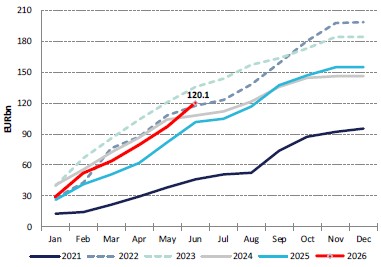
Source: Bloomberg, NORD/LB Floor Research
NordLB’s forecast has been raised €13bn, from €166bn to €179bn, implying some €59bn of euro benchmarks over the remainder of the year, with its analysts flagging two key wildcards.
“In addition to geopolitical events that could bring issuance activities in the covered bond market to a standstill,” they said, “the high maturities in 2027 (€177.3bn) especially represent a certain forecasting risk.
“We can well imagine that some issuers would therefore take advantage of a favourable market environment in October and November to engage in pre-funding and thereby somewhat alleviate the pressure on issuance activities heading into 2027.”
LBBW’s Rühlmann has lifted the bank’s forecast by €14bn, from €162bn to €176bn, with downside risks stemming from lower funding needs in some jurisdictions.
“On the one hand, due to increasing deposit growth amid an uncertain economic environment. On the other hand, due to sluggish mortgage growth.
“In non-euro jurisdictions in particular, other currencies might also seem more attractive,” added Rühlmann. “This year, higher issuance volumes were observed primarily in the US dollar and sterling segments.”
Florian Hillenbrand, senior covered bond analyst at Helaba, said a more modest increase, from his initial €163bn forecast to €169bn, may appear reasonable.
He noted that on a long term average, around 67% of total annual volume is placed in the first half of the year, which would translate into a €180bn-plus figure for 2026.
However, Hillenbrand said that despite elements of his bottom-up forecast proving too low (Canada and the UK) or too high (Sweden, Singapore and Austria), these balance out and overall his analysis and aggregate target remain valid, with front-loading also at play. He cited US mid-term but also German state elections as factors in the latter.
“A fundamental ‘on-off’ expectation regarding the primary market ultimately implies a ‘take what you can, while you can’ approach in anticipation of a potentially turbulent autumn,” said Hillenbrand.
Maureen Schuller, head of financials sector strategy at ING, also remains comfortable with her €165bn forecast. She meanwhile said that – particularly in light of 2027’s record redemptions – she sees no reason for supply to undershoot the near €50bn typically recorded in the second half – regardless of the rise in interest rate levels and the implications this may have on mortgage lending growth.
When it comes to the implications for market conditions and spreads, Commerzbank head of financials and covered bond research Ted Packmohr said that even if issuance exceeds his forecast of €170bn, net supply pressure is likely to remain low in the second half. With €156bn of redemptions this year, gross supply of €170bn would correspond to around €44bn of net supply pressure, given that €30bn of redemptions are going to the ECB without generating any reinvestment need.
“However, this is pretty much in line with the net supply volume that we have already seen in H1,” noted Packmohr, “meaning the market has already absorbed the corresponding pressure. For the remainder of the year, new issues and maturities should be much better balanced, as redemptions in H2 will be quite high in both absolute and percentage terms.
“A relatively large amount of money will therefore flow back to investors, which should limit supply-driven spread risks, even if gross supply for the year as a whole were to slightly exceed our expectations.”
Hillenbrand meanwhile said it is hard to find risk factors that would likely upset spread performance, save a “veritable” government crisis in core European countries or an “unprecedented” escalation of ongoing conflicts.
The benign outlook contributes to confidence that covered bonds will perform – by as much as 5bp, according to ABN Amro analysts. They noted that, on an index level, covered bond spreads tightened 3bp in the first half, in spite of the strong net positive supply, meaning that tightening across the year could reach 8bp.
As well as supply technicals, they cited attractive relative value versus government bonds and SSAs, and cheapness versus senior bonds.